The best mobile app development company USA buyers can hire is the one whose build approach, price range and working hours fit your product, not the one with the longest client list. Of the six companies below, TechAhead and Simpalm suit teams that want published cost ranges and a US-facing partner. WillowTree and Fueled suit established brands that can fund a premium studio. Intellectsoft suits enterprise programs. Eagle Technologies suits cost-focused teams that accept offshore delivery.
Every agency page promises "end-to-end" service, so you end up comparing marketing copy instead of facts. What you need is a short list of platforms, engagement models, price ranges and ownership terms, side by side. That is what the six profiles give you, followed by a cost table built from ranges that two of these firms publish, a native versus cross-platform guide, and the questions to ask before you sign.
This blog belongs to Eagle Technologies, so we list ourselves first and label ourselves plainly. We are headquartered in South Africa with a delivery centre in Jaipur, India, not in the United States. The other five are US-based or US-facing, and we keep our claims about them to what is publicly known. Confirm current details with each company before you sign anything.
1. Eagle Technologies
Eagle Technologies is the offshore option on this list: a South Africa headquarters with engineering in Jaipur, India, serving US teams that want mobile capacity at offshore economics.
What it offers
Eagle Technologies builds native iOS and Android apps and cross-platform apps in Flutter and React Native, with App Store readiness built into delivery. The company was founded in 2012, has more than 50 specialists and reports 500+ delivered projects across web, mobile, cloud and marketing work.
Mobile design is sold as its own service. It covers native-feeling UI that follows platform patterns, delivered as component libraries that engineers can implement in SwiftUI, Jetpack Compose or a cross-platform stack. Fixed-scope design pilots usually finish within 2 to 6 weeks, and revision rounds are scoped upfront. Build work runs in two-week sprints with weekly reporting, and it starts with a free 60-minute strategy session.
Who it suits
Eagle Technologies fits US startups, digital agencies and in-house IT teams that need extra iOS or Android capacity, or a full build, without paying onshore studio rates. If you search for a US mobile app development company and your priority is budget and flexibility, it belongs on your comparison sheet. It does not belong there if you need a US-registered vendor or on-site workshops.
Offshore delivery only saves money when you plan the time-zone overlap on day one.
The trade-off is time. Working hours are tuned for IST overlap with US teams, which in practice means a narrow window early in the US day. Agree a fixed weekly call and written updates before the first sprint, so the gap never becomes a blocker.
Pricing and engagement
Eagle Technologies does not publish a mobile app price list. It scopes the work after the strategy session and sends a proposal with milestones. The clearest route to a known cost is hiring dedicated developers:
- Hourly, part-time or full-time models
- Start within 3 to 7 business days after a discovery call and profile shortlist
- A paid trial of 2 to 4 weeks before you commit
- NDA-ready contracts with work-for-hire or IP assignment terms
- iOS developers in Swift, SwiftUI, Xcode and CoreData, Android developers in Kotlin, Jetpack Compose and Material 3
- No lock-in contracts and no hidden costs
Invoices can be issued in INR or ZAR, so confirm how USD billing works before you sign.
2. TechAhead
TechAhead is a US-facing company with a broad stack and the most detailed published pricing of the six, which makes it the easiest to benchmark against.
What it offers
TechAhead builds native iOS apps in Swift and Objective-C, native Android apps in Kotlin and Java, and cross-platform apps in Flutter and React Native. It also covers web apps and wearables, and says it has operated since 2009. The process moves from discovery and UX design through architecture, two-week sprints, QA and store submission, with post-launch support built into each engagement.
The delivery model is hybrid. Its site says the California team handles client strategy and architecture planning, while the Noida team does the iOS, Android, Flutter and React Native coding. That makes it a US-facing company with offshore engineering, which is worth knowing when you compare it with a fully onshore studio.
Who it suits
TechAhead fits mid-size and enterprise buyers in regulated sectors such as health, fintech and insurance. It lists SOC 2 Type II, ISO 27001:2022, HIPAA and GDPR among its compliance standards, and its case studies cover fitness, banking, IoT and sports apps. Ask for the actual certificates during procurement.
Choose TechAhead when compliance paperwork matters as much as the code.
Startups can use it too, because the MVP range is public. Be aware that the lowest published tier starts at $50,000, which is above what a simple first app costs at some other firms on this list.
Pricing and engagement
TechAhead states three project tiers: MVPs at $50,000 to $100,000, medium-scale apps at $100,000 to $250,000, and large or enterprise-grade builds at $250,000 to $500,000. For hourly work it quotes $25 to $49 for most developers and $60 to $125 for high-end ones.
Contract terms are clear on ownership. Its site says clients keep full rights to design, source code and generated content, and that an NDA is signed before any project begins. You can also hire dedicated iOS, Android or Flutter developers instead of buying a fixed-scope project.
3. Simpalm
Simpalm is a good first call for teams that want a US office, a plain process and clear timelines, and it publishes a lower price range than most agencies.
What it offers
Simpalm was founded in 2009 around mobile apps and still calls them its biggest offering. It builds native apps in Kotlin and Swift, cross-platform apps in React Native, .NET MAUI or Flutter, and progressive web apps for browser-based cases such as news or kiosk apps. Backend development, App Store and Play Store submission, mobile DevOps and code audits sit beside the build work.
Its process has six stages from discovery to ongoing support, and it says discovery typically finishes in under two weeks. Offices in Chicago, Washington DC and New York give US buyers an in-person option, which most offshore-heavy providers cannot match.
Who it suits
Simpalm suits startups, nonprofits and first-time app owners who want a straightforward partner. Its site lists clients such as the University of Maryland and AudiobooksNow, and cites about 200 reviews on third-party platforms at a 4.9 average. That figure is self-reported, so read the reviews yourself.
Simpalm is the lower-budget US-office pick, not the enterprise-compliance pick.
It also offers to place a single mobile developer on your team if you already have a designer and a web developer. That is useful when you only lack mobile engineering and do not need a full agency.
Pricing and engagement
Simpalm states a typical range of $20,000 to $120,000 and says the exact number depends on screens, backend work, integrations and UI depth. It offers an NDA before you share your idea. Its published timelines are:
- Simple app with basic screens: 4 to 6 weeks
- Advanced product with custom backend, integrations and polished UI/UX: 3 to 6 months
- Discovery and ideation: usually under two weeks
Its FAQ also notes that many US clients now choose hybrid shoring, with a senior US team plus offshore or nearshore engineers, to balance quality and price.
4. WillowTree
WillowTree is the premium pick for large brands, a Virginia-based team that is part of TELUS Digital and built for programs that need many disciplines at once.
What it offers
WillowTree is based in Charlottesville, Virginia, and belongs to TELUS Digital. It develops iOS, Android and other-platform apps for large consumer and enterprise brands, and its work spans product strategy, design and engineering rather than code alone.
Scale is the main reason to shortlist it. A big release needs product, design and engineering teams working in parallel, plus QA and release management, and that is hard for a small studio to staff. If your roadmap runs several quarters, a firm of this size can keep every workstream moving.
Who it suits
WillowTree suits established brands and enterprises with funded, multi-release roadmaps and internal stakeholders who need a structured partner. A US-based team in one time zone also helps when legal, security and brand teams join every review.
A firm built for large programs is a poor fit for a first MVP on a tight budget.
If you are validating an idea with one or two core features, a leaner option such as Simpalm or an offshore team will usually get you to market with less spend.
Pricing and engagement
WillowTree does not publish a price list, so budget talks begin with a scoped proposal. Ask for a phased estimate with a fixed price for the first release, not just a monthly team rate. Questions worth raising on the first call:
- Which roles are on the team in each phase, and are they dedicated or shared?
- Who owns the design system and the source code at handover?
- How does knowledge transfer to your in-house engineers after launch?
Compare the answer against the ranges in the cost section, and expect multi-team programs to sit well above the MVP tiers.
5. Fueled
Fueled is a New York-based mobile app development company in the USA that suits teams wanting a partner to shape the product, not just write the code.
What it offers
Fueled develops apps for iOS, Android and other major platforms from New York. As with any agency in this category, the useful question is not whether it builds apps, but how much of the product thinking it brings: scoping, design, engineering and release in one team.
Ask to see work in your category and to speak with its technical lead before the proposal stage. A company that has shipped many apps will have a repeatable release process and can describe it in specifics, from build pipelines to App Store review handling.
Who it suits
Fueled suits startups and brands that want one accountable partner for an iOS or Android launch and are willing to pay a US studio rate for it. It makes more sense when the app is central to the business than when it is a side project.
Pick a studio for products where the app is the business, not an add-on.
If your app is an internal tool or a companion to an existing website, a cheaper cross-platform build from a smaller team is often enough, and you can spend the savings on post-launch iteration.
Pricing and engagement
Fueled quotes per project, so expect a scoped estimate rather than a rate card. To compare it fairly with the other five, give each company the same one-page brief covering platforms, core features, integrations and launch date. Then check:
- Whether the estimate covers design, backend, QA and store submission
- What a post-launch maintenance retainer costs per month
- Whether the contract assigns IP and source code to you at final payment
An estimate that omits any of these is cheaper on paper only.
6. Intellectsoft
Intellectsoft is a California-based company that builds consumer and enterprise apps and fits organizations with legacy systems to connect.
What it offers
Intellectsoft is a California-based provider of mobile app design and development for both consumer and enterprise use. It builds iOS and Android apps, and enterprise mobile work usually means more than screens: integrations with ERP, CRM and identity systems, plus security reviews and role-based access.
That integration work is where enterprise projects slip. When you speak with Intellectsoft, ask how it documents APIs and data flows early, and whether discovery produces a written architecture you can keep if you change vendors.
Who it suits
Intellectsoft suits mid-size and large companies that need a mobile app to sit on top of existing back-office systems, such as field service, logistics or internal workforce tools. It also suits teams building customer-facing apps that must meet company security policies.
For enterprise apps, the integration plan matters more than the interface design.
Smaller teams building a standalone consumer app will usually find simpler, cheaper partners. Match the vendor to the complexity of your problem, not to its brand.
Pricing and engagement
Expect a scoped proposal rather than published rates. Enterprise engagements often run in phases, so ask for the cost of a paid discovery phase first and treat the build estimate as provisional until discovery ends. Points to settle in writing:
- Who owns source code, designs and documentation
- Support terms after release, including response times for critical bugs
- Compliance responsibilities if your app handles health or payment data
Use the ranges in the next section to sanity-check any number you receive.
What a US mobile app project costs
Most US-facing agencies price a serious MVP between $50,000 and $100,000, while simple apps can start near $20,000. Only two of the six firms above publish numbers, so the table sets their own figures side by side.
Published price ranges compared
The ranges below come from each company's own statements and describe typical projects, not guaranteed quotes. The firms define scope differently, so read them as bands rather than exact comparisons.
| Company | Scope | Published range |
|---|---|---|
| TechAhead | MVP with core features | $50,000 to $100,000 |
| TechAhead | Medium-scale app with integrations | $100,000 to $250,000 |
| TechAhead | Large or enterprise-grade solution | $250,000 to $500,000 |
| Simpalm | Typical mobile app project | $20,000 to $120,000 |
TechAhead also quotes hourly rates of $25 to $49 for most developers and $60 to $125 for senior ones. Simpalm's ceiling of $120,000 sits just above TechAhead's MVP ceiling of $100,000. That suggests $50,000 to $100,000 is a realistic MVP band, and $20,000 is the floor for a simple app.
Plan on $50,000 to $100,000 for a serious MVP, and treat $20,000 as the floor for a simple app.
A worked example
Say your MVP is scoped at 1,200 hours of design, build and testing. That number is an assumption for illustration, not a quote. At $40 an hour, inside TechAhead's typical band, the project costs $48,000. At $100 an hour, inside its high-end band, the same hours cost $120,000.
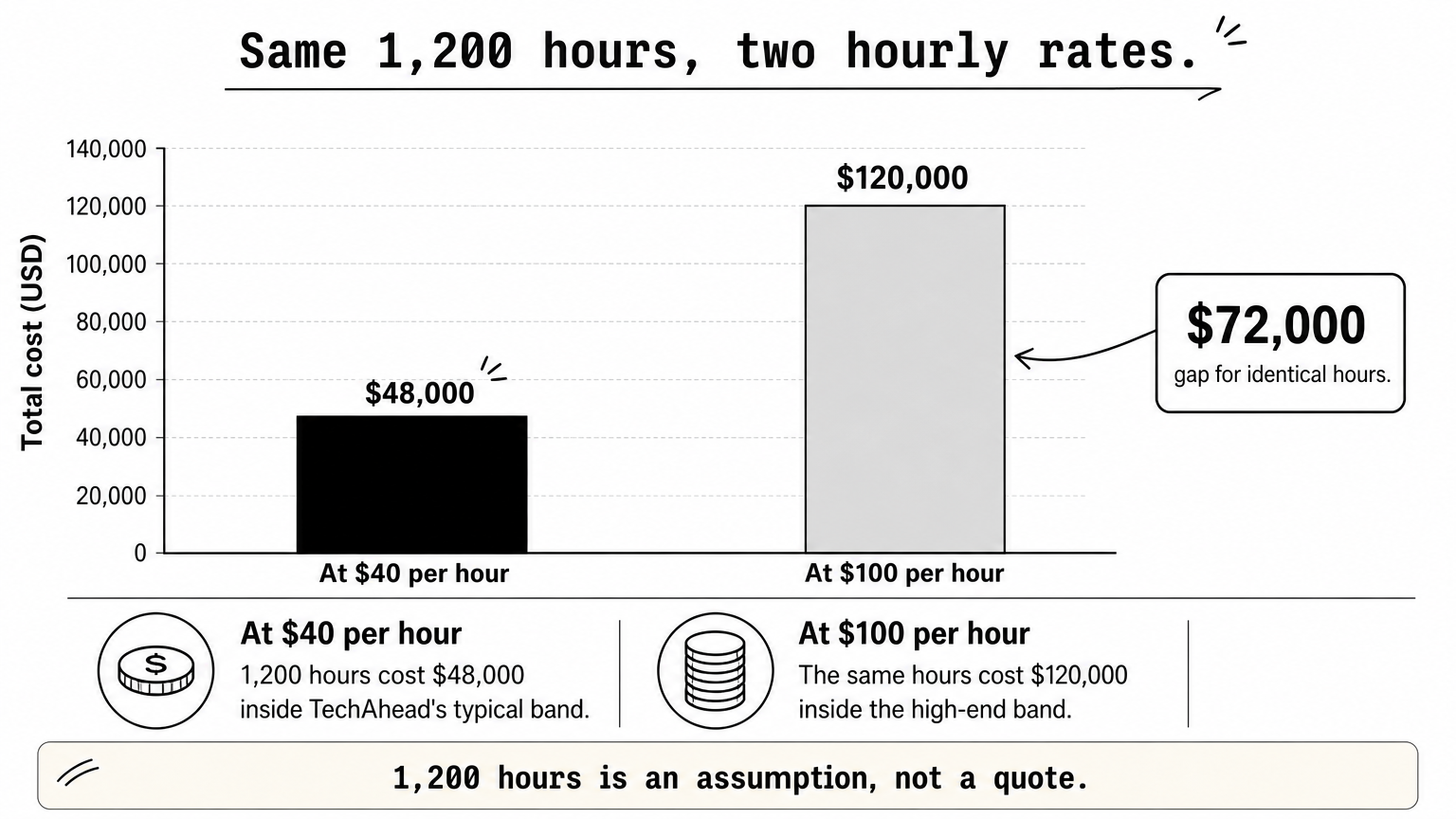
The gap is $72,000 for identical hours. In real projects the hours also differ, because a more senior team may write less rework. That is why you should compare total scoped proposals, not hourly rates alone.
What moves the price
Rate is only one input. These factors change the hours:
- Number of platforms and whether you build native twice or cross-platform once
- Backend, admin panel and third-party integrations
- Compliance needs such as HIPAA or PCI
- Depth of UI design and animation
- Post-launch maintenance, which is usually a monthly retainer
Cut scope to two or three core features for the first release, and you control the biggest cost driver you have.
How to choose a US mobile app development company
Choose by matching build approach, shoring model and contract terms to your product, then verify with references. Use this process on any US mobile app development company, including the six above.
Match the build approach to your app
Native apps suit heavy graphics and deep hardware access, while cross-platform frameworks suit faster, cheaper launches on both stores from one codebase. Progressive web apps work when users can stay in a browser.
| Approach | Best for | Typical tools |
|---|---|---|
| Native | Graphics-heavy apps, deep device features, top performance | Swift, Kotlin |
| Cross-platform | Faster launch on iOS and Android, one codebase, lower cost | Flutter, React Native |
| Progressive web app | Content, information and kiosk-style apps | Browser-based |
Eagle Technologies, TechAhead and Simpalm all state that they build native, Flutter and React Native apps. Ask any shortlisted company to explain why it recommends one approach for your app, and be wary of a one-size answer.
Decide between onshore, offshore and hybrid
An onshore team works in your time zone and under US law, and it charges for both. An offshore team costs less per hour but adds a time gap. A hybrid model puts a senior US lead in front of offshore engineers, and it is the structure TechAhead describes and the one Simpalm says many US clients now choose.

Pick onshore when stakeholders need daily access and the budget allows. Pick hybrid or offshore when cost per feature matters most and you can run on a weekly rhythm. Whichever you choose, agree meeting windows in writing.
Questions to ask before you sign
Ask each shortlisted company the same questions and compare the written answers:
- Who owns the source code, designs and IP, and when does ownership transfer?
- Will you sign an NDA before I share the idea?
- Who submits the app to Apple's App Store and Google Play, and what if it is rejected?
- What does post-launch maintenance cost and include?
- Can I speak with two past clients in my industry?
- Which security and compliance standards apply to my data?
Any company that hesitates on ownership or references is giving you its answer.
The company that answers ownership and maintenance questions in writing is the one to keep.
Your shortlist and next step
For a best mobile app development company in USA shortlist, pick two or three firms that match your budget and compliance needs, send each the same brief, and compare scoped proposals. TechAhead and Simpalm give you published numbers to check against, WillowTree and Intellectsoft suit larger programs, Fueled suits product-led launches, and Eagle Technologies suits teams that value offshore economics and can work around a time-zone gap.
If offshore delivery sounds right for your app, we are happy to look at your scope and tell you plainly whether we fit. Start with a free 60-minute strategy session with Eagle Technologies. You leave with a clearer scope, a build approach and a realistic view of timeline and cost, whether or not we end up working together.