The best cross platform mobile app development company for you is the one that names its frameworks, shows a clear delivery process, and lets you leave without a lock-in contract. Eagle Technologies suits businesses that want Flutter or React Native with flexible terms. Konstant Infosolutions suits larger projects that need a deep bench. Simpalm suits teams that want a wide framework menu, and SCAND suits buyers who put cost first.
Building iOS and Android apps from a single codebase can cut build time and maintenance cost. But every agency now claims cross-platform skills, and most websites read the same. You need to know which framework a team actually recommends, who does the work, and what happens after launch.
This list compares four companies on what they offer, who they suit, and what you should verify before signing. Eagle Technologies, the team behind this blog, is listed first. Judge it by the same checks as the other three. A comparison table, a framework primer, and a question list follow the four profiles.
1. Eagle Technologies
Eagle Technologies builds cross-platform apps with Flutter and React Native, and it also writes native iOS and Android code when a project needs it. The company was founded in 2012, has more than 50 specialists, and works from a South Africa headquarters and a delivery centre in Jaipur, India.

What they offer
The Mobile App Development service covers cross-platform builds that are App Store ready and performance-first. A separate Mobile App Design service produces iOS and Android interfaces that follow platform patterns, with component-level specs your engineers can build from. Fixed-scope pilots usually finish within 2 to 6 weeks.
- Process: a free 60-minute strategy session, two-week sprints, and weekly reporting.
- Terms: no hidden costs, no contract lock-ins, NDAs as standard, and invoicing in INR or ZAR.
- Extra capacity: dedicated Android and iOS developers who start in 3 to 7 business days, with a 2 to 4 week paid trial.
Eagle's strongest point is flexibility: you can start with a short pilot and walk away without a lock-in.
Who it suits and what to verify
This option suits startups and established brands in South Africa, India, and abroad that want rand billing and a team they can reach in one working day. It also suits companies that may add dedicated developers later.
Ask which framework the team would pick for your app and why. Request live apps built with Flutter or React Native, and confirm who owns the code under the contract.
2. Konstant Infosolutions
Konstant Infosolutions is a long-running cross-platform company, active since 2003, with more than 180 specialists according to published profiles of the firm. Its age and size are its main selling points.
What they offer
The company offers mobile app development across platforms, and a large team lets it staff several workstreams at once. We could not confirm its framework list, pricing, or engagement models from public sources, so ask for them directly.
- Request the exact stack used on comparable projects.
- Request a named team lead, not just a sales contact.
- Request a written scope with milestones.
A large team helps only if the people assigned to your app are experienced in your chosen framework.
Who it suits and what to verify
Konstant suits larger or multi-phase projects, such as an app with a backend, an admin portal, and later feature releases. Companies that want one vendor for a long roadmap will value the history.
Years in business do not prove cross-platform depth. Ask how many of its recent projects used Flutter or React Native, and speak to a past client before you commit.
3. Simpalm
Simpalm is a US-based cross-platform company. It says its developers work in React Native, Xamarin, Flutter, and HTML5, which is one of the widest framework lists among agencies.

What they offer
Simpalm builds cross-platform mobile apps and lets the framework follow the project. That breadth helps if you already have a codebase in one of those tools. It also means you must ask which one it would recommend for yours.
Two items on its list need care. Xamarin reached end of support in May 2024, and Microsoft points developers to .NET MAUI. HTML5 apps run web content inside a wrapper, so they usually feel less native than Flutter or React Native.
A long framework list is useful only when the agency can tell you which one to avoid.
Who it suits and what to verify
Simpalm suits teams with an existing Xamarin or web-based app that need a partner who knows the older stack. It also suits buyers who want to compare frameworks before choosing one.
Ask how it would handle a Xamarin migration and what it recommends for a new build. Check working-hour overlap with your time zone, since the team is US-based.
4. SCAND
SCAND offers cross-platform mobile app development and says it delivers projects on time with significant cost savings. Those are its own claims, so treat them as questions to test.
What they offer
SCAND covers cross-platform mobile builds as part of a wider software service. Its public pages focus on delivery and cost rather than named frameworks, so you need to ask about the technology stack during the first call. Pricing is not published.
- Ask what the savings are measured against.
- Ask for a fixed-scope quote with milestones.
- Ask whether the quoted team is the team that builds.
Cost savings only count when the quote states what is included and what is extra.
Who it suits and what to verify
SCAND suits cost-led buyers with a defined scope who want a competitive quote to compare against others. Confirm its location and time-zone overlap early, because daily communication shapes delivery as much as price does.
Request references from clients with similar apps. Ask what happens if a deadline slips and how change requests are priced.
How to choose between these companies
Choose by framework fit, delivery process, and contract terms, in that order. A cheap quote from a team using the wrong framework costs more in rewrites than it saves.
Side-by-side comparison
| Company | Stated cross-platform stack | Scale or history |
|---|---|---|
| Eagle Technologies | Flutter, React Native (plus native) | Founded 2012, 50+ specialists |
| Konstant Infosolutions | Not listed in public sources | Since 2003, 180+ specialists |
| Simpalm | React Native, Xamarin, Flutter, HTML5 | US-based company |
| SCAND | Not listed in public sources | States on-time delivery and cost savings |
Flutter or React Native
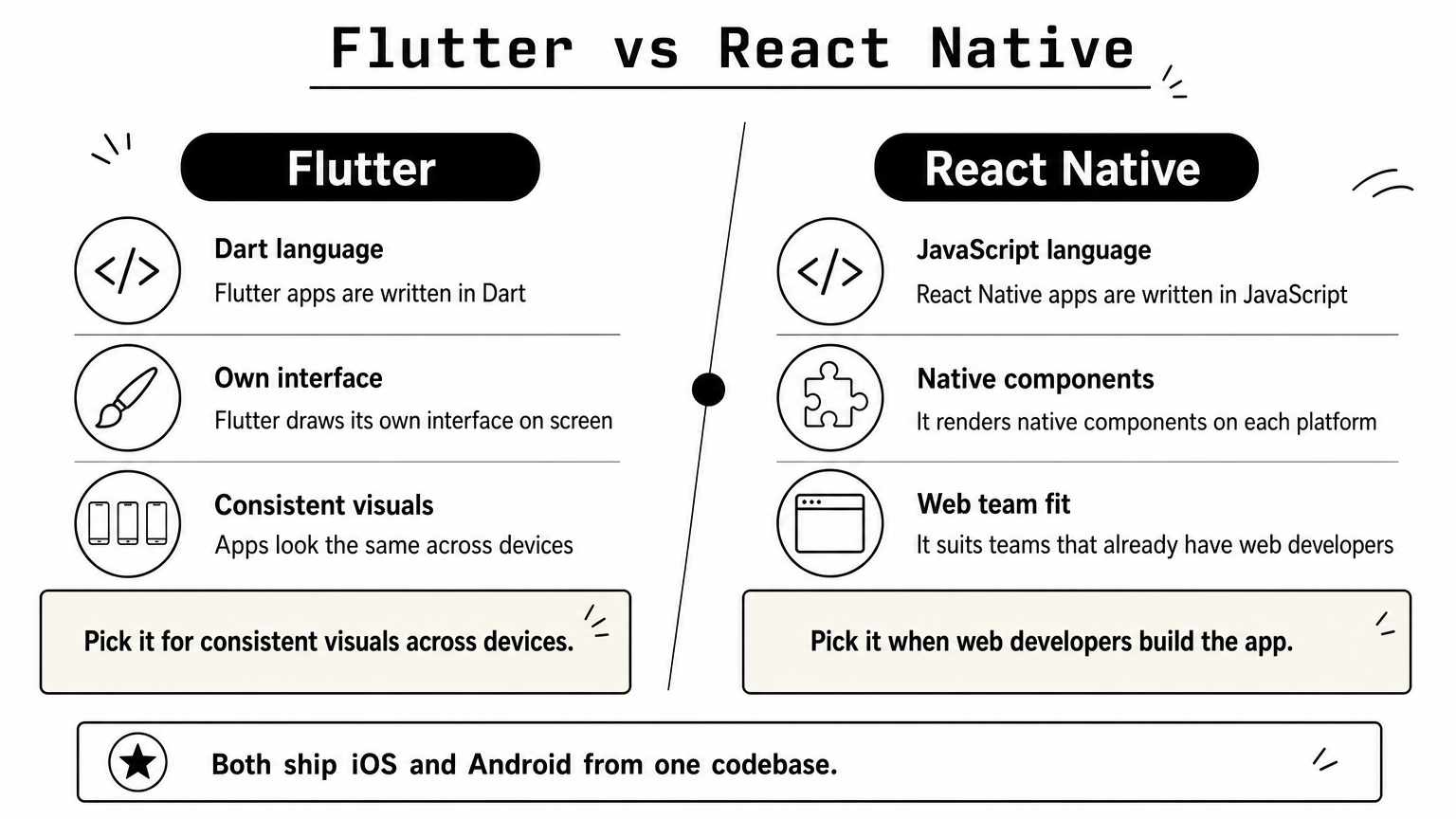
Both let you ship iOS and Android from one codebase. Flutter uses Dart and draws its own interface, which gives consistent visuals across devices. React Native uses JavaScript and renders native components, which suits teams with web developers. Ask each agency to justify its pick for your app.
Questions to ask before you sign
- Which framework do you recommend, and what would make you choose native instead?
- Who writes the code, and can I meet them?
- How do sprints, demos, and reporting work?
- Who owns the source code and design files?
- What does post-launch support cost, and can I end it?
Where to go from here
The right cross-platform partner is the one whose framework choice, team, and contract terms you can verify. Shortlist two or three companies, ask the five questions above, and compare written scopes before you compare prices.
If Flutter or React Native fits your plan, Eagle Technologies can scope your app after a free 60-minute strategy session. Talk to Eagle Technologies about your cross-platform app and bring your questions.