The right enterprise mobile app development company depends on how much of the project you want to run yourself. A full-service partner with offshore delivery suits you if you need a mobile app tied into ERP and CRM systems at a sensible cost. A local studio suits you if you want in-person workshops. A global consultancy suits you if compliance and scale outweigh budget. Dedicated developers suit you if you already have a product owner and an architect.
Most vendor websites use the word "enterprise" freely, yet few explain how they work, who carries the delivery risk, or what you actually receive at handover. That makes a shortlist hard to build. Comparing company names tells you less than comparing the delivery model behind each name.
This article walks through four types of vendor, with what each one does, who it fits, and where it falls short. Eagle Technologies, the publisher of this blog, is the first type, so weigh that placement accordingly. After the four types you get a side-by-side table, the questions to put to every vendor, and a simple way to test a vendor before you commit.
1. Eagle Technologies: full-service partner
Eagle Technologies is a full-service partner that builds the mobile app and the enterprise systems behind it, with South African headquarters and an engineering centre in Jaipur, India. It suits businesses that need one team across app, integrations, and design.
How it works
Eagle was founded in 2012 and has more than 50 specialists. The mobile side covers native iOS and Android plus cross-platform builds in Flutter and React Native. The enterprise side covers ERP integrations, custom portals, workflow automation, and multi-tenant SaaS platforms.
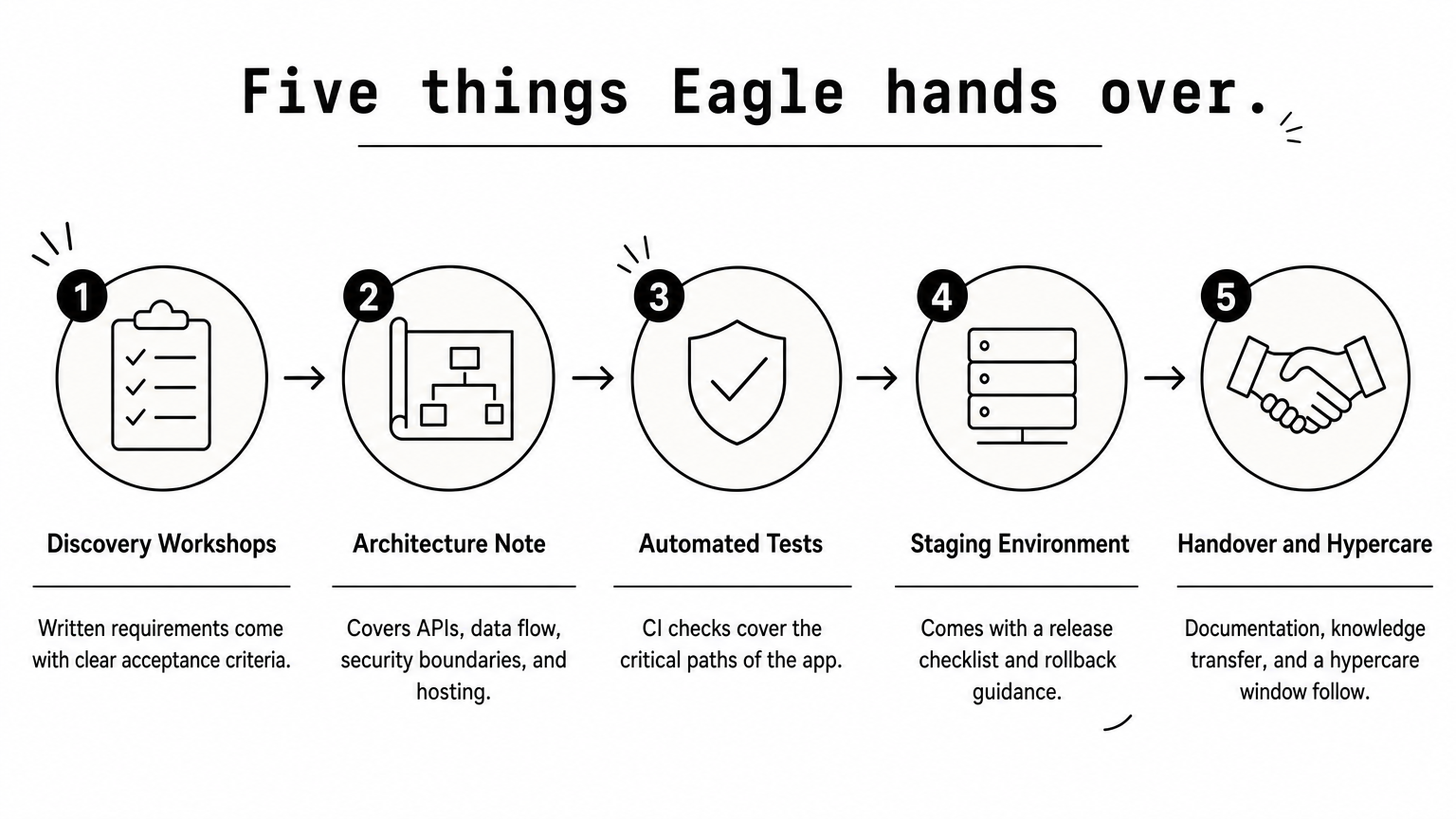
Delivery is phased, so pilot user groups validate workflows before a company-wide rollout. Fixed-scope pilots usually finish in 2 to 6 weeks, with demos weekly or bi-weekly. A typical engagement hands you:
- Discovery workshops and written requirements with acceptance criteria
- An architecture note covering APIs, data flow, security boundaries, and hosting
- Automated tests and CI checks on critical paths
- A staging environment, release checklist, and rollback guidance
- Documentation, handover, and a hypercare window with knowledge transfer
A good enterprise vendor hands over documentation and rollback guidance, not only a working build.
Who it suits
Eagle fits South African and wider African businesses that want a mobile app connected to existing back-office systems and want to control cost. Billing can be in ZAR or INR. NDAs are standard and there are no lock-in contracts. It also suits teams that want design, development, and later SEO or marketing support from one partner.
Trade-offs
Engineering happens in Jaipur, and India Standard Time runs 3.5 hours ahead of South Africa. Daily overlap exists, with the South African office coordinating. If you insist on your supplier sitting in your boardroom each week, a local studio is a better fit.
2. Local South African app studio
A local studio is a small to mid-sized agency in your own city that builds apps with a team you can meet in person. Several South African studios list enterprise work among their services.
How it works
Musato Technologies in Durban lists iOS and Android apps, enterprise solutions, AI integration, and cloud apps. The formula lab in Cape Town lists custom and enterprise application development alongside hybrid and progressive apps. iSolve Mobility describes itself as specialising in mobile and enterprise applications. Check each studio's own site for current services.
Expect in-person discovery workshops and a project team of a handful of people. Pricing is usually per project or per sprint.
Who it suits
A local studio fits a first enterprise app, a project with many internal stakeholders who want face-to-face sessions, or a procurement policy that favours local suppliers. It also works well when the app is a contained tool, such as a field-service app for one department.
Trade-offs
Rates are usually higher than offshore delivery, and capacity is thinner. If two key people leave mid-project, a small studio can stall. Ask who would replace them and how fast. Ask also whether the studio has built ERP integrations before, since a polished consumer portfolio does not prove that skill.
Judge a local studio by its integration experience, not by how good its consumer app screenshots look.
3. Global enterprise consultancy
A global consultancy is a large agency or technology consultancy that runs strategy, design, engineering, and support across several offices. It is built for programmes with heavy governance.
How it works
These firms usually organise work in formal phases with steering committees, security reviews, and documented change control. You deal with a delivery manager, a solution architect, and a larger pool of specialists. Contracts tend to be long and detailed. A multi-country rollout is where this structure pays for itself.
Who it suits
Pick this type for regulated sectors such as banking or insurance, or for a rollout across many countries with strict audit demands. It also suits a board that wants a name with deep references behind the project.
Trade-offs
Cost is typically the highest of the four types, and sales cycles run longer. Senior staff often appear in the pitch and then step back, so ask exactly who will write and review the code. For a single app with a clear scope, this model is often more process than you need.
Pay for a consultancy's governance only when your risk profile truly demands it.
4. Dedicated developer provider
A dedicated developer provider supplies vetted mobile engineers who work as an extension of your team, while you manage the backlog and priorities.

How it works
Eagle offers this model too. You can hire an Android developer working in Kotlin and Jetpack Compose, or an iOS developer working in Swift and SwiftUI, hourly, part-time, or full-time. Start time is typically 3 to 7 business days, and a 2 to 4 week paid trial lets you test fit. Contracts are NDA-ready with work-for-hire or IP assignment terms.
Who it suits
This works if you already have a product owner, a technical lead, and a QA process, and you lack hands. It suits an in-house IT team that needs extra capacity for new features, modernisation, or a surge before a launch.
Trade-offs
You carry the delivery risk. The provider answers for the developer's skill, not for the app's success. Without your own architecture and release discipline, a dedicated developer model drifts quickly.
Hiring developers buys capacity, not accountability, so make sure you can supply the accountability yourself.
How to shortlist a vendor from these four
Choose by matching delivery model to your internal strengths, then confirm with a short paid pilot. The table sets the four types side by side.
Comparison at a glance
| Type | Best for | Cost model | Main risk |
|---|---|---|---|
| Full-service partner (Eagle Technologies) | App plus ERP/CRM integration on a managed budget | Project, retainer, or dedicated team | Time-zone gap for on-site work |
| Local studio | First app, in-person workshops | Per project or sprint | Thin capacity |
| Global consultancy | Regulated, multi-country programmes | Large fixed or phased contracts | Cost and process weight |
| Dedicated developers | Teams with product and QA leadership | Hourly, part-time, or full-time | You own delivery risk |
Questions to ask every vendor
Put these to each candidate in writing so you can compare answers:
- Which enterprise apps have you shipped that integrate with an ERP or CRM?
- Who writes the code, and who reviews it?
- What do I own at handover: source code, documentation, and infrastructure access?
- How do you handle a critical production issue, and who is on the escalation path?
- Can I see a fixed-scope pilot proposal before a full quote?
Test with a pilot
A pilot removes most of the guesswork. A 6-week pilot with two-week sprints gives you three sprint reviews, or up to six demos if the vendor demos weekly. By the end you have seen real working software, the team's communication, and how they handle changing requirements. Judge that evidence over any slide deck.
A six-week pilot teaches you more about a vendor than six weeks of proposals.
Choosing between the four
Each type solves a different problem. A full-service partner covers app and integration cost-effectively, a local studio gives you proximity, a global consultancy gives you governance, and dedicated developers give you capacity. Match the model to the gaps in your own team, ask the same written questions of every candidate, and let a short pilot settle the final choice.
If a full-service partner fits your project, book a free strategy session with Eagle Technologies. It is a 60-minute review of your tech stack and growth blockers, with no obligation, and it gives you a clear scope to compare against any other quote.