
How much does Flutter app development cost? Most business apps land between $30,000 and $80,000. The full market range runs from about $5,000 for a simple MVP to $300,000 or more for a SaaS, enterprise, or multi-platform product. The figure is the total you pay to design, build, test, launch, and maintain an app on Flutter, Google's free, open-source framework that produces iOS and Android apps, and web and desktop apps, from one codebase. Flutter itself costs nothing. Your money goes to people, hosting, and upkeep.
Quotes for what looks like the same app can differ tenfold, so a single number helps nobody. This guide shows why the range is so wide and how to build your own estimate step by step. It covers which features, design choices, and platforms move the price, what developers charge by region, and which costs appear after launch. You also get a worked example and a checklist for comparing quotes.
Eagle Technologies builds Flutter and React Native apps from its Jaipur delivery centre, with headquarters in South Africa. This guide is written from the side of the table where quotes get built. The ranges are market figures, not a price list.
Why Flutter app costs range from $5,000 to $300,000
A Flutter app can cost $5,000 or $300,000 because "an app" covers everything from a three-screen internal tool to a marketplace with live chat, payments, and an admin back office. Scope sets the price, and the framework only decides how far your budget stretches. Understanding that early stops you from judging quotes against the wrong yardstick.
What most Flutter apps cost
Most business apps cost $30,000 to $80,000, and a typical app with standard features sits near $50,000 and takes three to five months. The table sets the common tiers side by side.
| App tier | Typical cost | Typical timeline |
|---|---|---|
| Simple MVP or internal tool | $5,000 to $25,000 | 1 to 3 months |
| Standard business, B2C, or ecommerce app | $25,000 to $100,000 | 3 to 6 months |
| SaaS or enterprise app | $80,000 to $250,000 | 5 to 9 months |
| Super app or multi-platform product | $150,000 to $300,000+ | 8 to 12 months |
Published guides disagree on the floor. Some start at $15,000 or $20,000 and others at $50,000. The gap comes from what the figure includes. A price that covers design, QA, project management, and a backend will always beat a developer-hours-only price by a wide margin. A tightly scoped MVP with a few core features can cost $8,000 to $15,000 and take about four weeks, provided it uses template UI and a managed backend.
Why the same idea gets very different quotes
Two agencies can read the same brief and return numbers $80,000 apart. Four differences usually explain it:
- What is included. Design, QA, project management, backend work, and post-launch support are each optional line items.
- Who builds it. Hourly rates differ by more than five times between regions.
- How much you build first. A full launch costs far more than a core-feature release.
- How polished the interface is. Standard Material widgets cost little. A custom brand system with animation does not.
Two quotes only compare once they cover the same scope, the same team, and the same support after launch.
Where Flutter saves money compared with native
Flutter typically costs 30% to 40% less than building separate native iOS and Android apps. One codebase replaces two, so you need fewer developers, fewer design hand-offs, and one test cycle instead of two. Native work in Swift and Kotlin duplicates screens, business logic, and bug fixes, and the maintenance burden roughly doubles with it.

The saving depends on your target. If you only need one platform, Flutter's advantage shrinks to almost nothing. Native is also the better choice for heavy 3D games, real-time video processing, or features that lean on deep operating-system access. For a business app that must reach both iPhone and Android users, Flutter is usually the cheaper route to the same result.
How to estimate your Flutter app budget
You can estimate your Flutter app budget in five steps: define the scope, rank the features, price them, apply a team rate, and add a buffer. Done in this order, you arrive at a range you can defend when real quotes come in.
Five steps to a defensible estimate
Start with the product, not the price. A vague idea produces a vague quote, and vague quotes grow once development starts. Work through these steps on paper before you contact anyone.
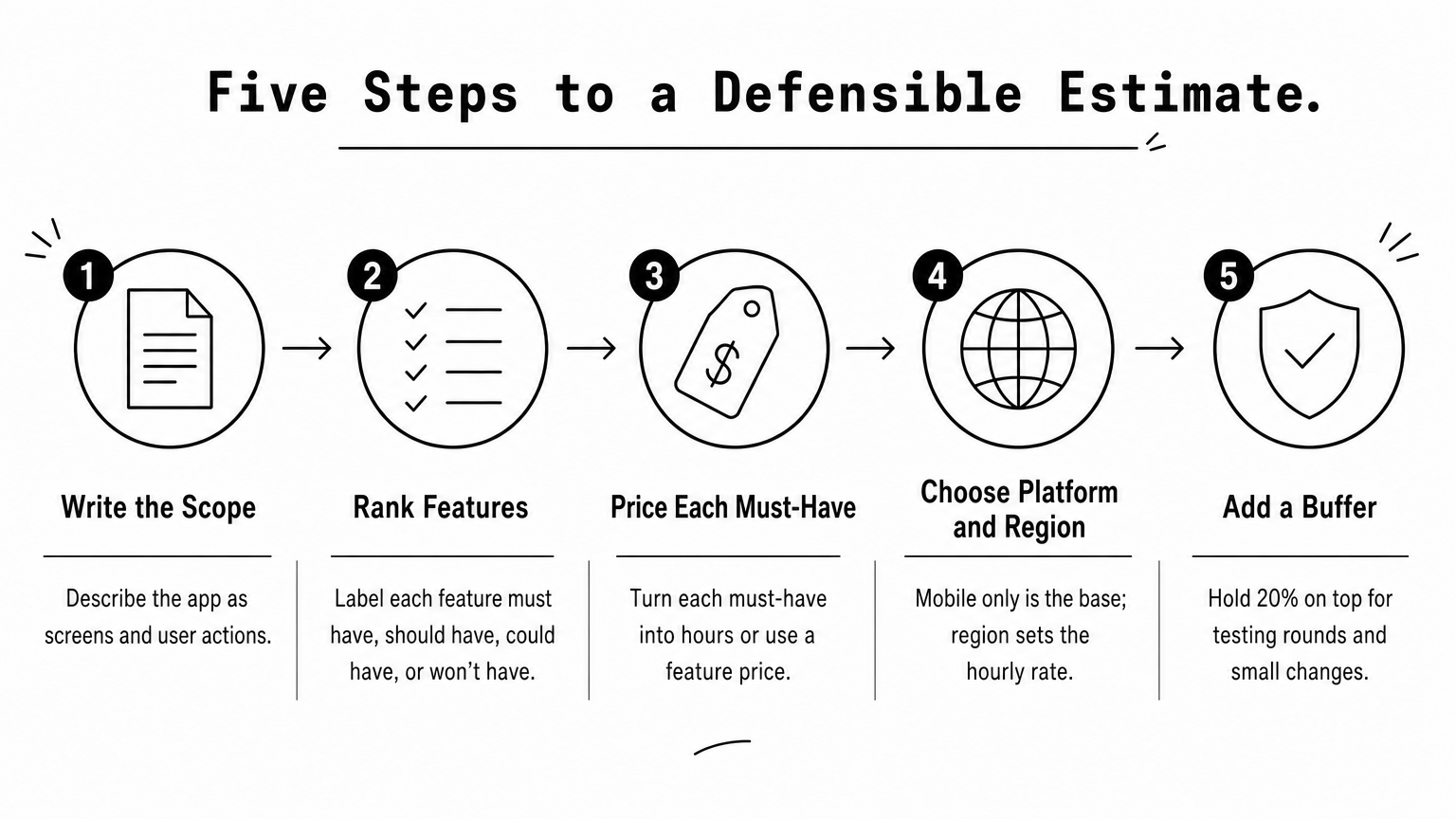
- Write the scope as screens and user actions. "Users sign in, browse products, pay, and track orders" is estimable. "An app like Uber" is not.
- Rank features with MoSCoW. Label each one must have, should have, could have, or won't have for now. Price only the must-haves for version one.
- Price each must-have. Use the feature table in the next section, or ask a developer to turn each item into hours.
- Choose platforms and team region. Mobile only is the base. Adding web or desktop raises the total, and region sets the hourly rate.
- Add a 20% buffer. Testing rounds, feedback, and small changes always appear. Budget for them now so they do not become a surprise later.
Worked example: a 1,000-hour app at four hourly rates
Take a lean mid-complexity app with sign-in, a product catalogue, payments, push notifications, and a simple admin panel for iOS and Android. Assume it needs 1,000 blended team hours across developers, design, QA, and project management. The only variable is the rate you pay.
| Blended hourly rate | Build cost | 20% buffer | Budget to hold |
|---|---|---|---|
| $25 | $25,000 | $5,000 | $30,000 |
| $50 | $50,000 | $10,000 | $60,000 |
| $100 | $100,000 | $20,000 | $120,000 |
| $150 | $150,000 | $30,000 | $180,000 |
The same scope spans $30,000 to $180,000, which is exactly the spread you see in published ranges. Read the table as a starting frame, not a verdict. A cheaper team may need more hours for the same output, and a senior team often needs fewer. Hours and rate must be judged together, which the section on comparing quotes covers.
Cost equals hours multiplied by rate, so control the hours with scope and choose the rate with eyes open.
What drives Flutter app development cost in detail
Four things move the cost to build a Flutter app most: features, design, platform coverage, and security or compliance needs. Features cause the largest swings, because each one adds screens, logic, testing, and often a backend.
Feature costs
The figures below are typical agency prices at mid-market rates. They scale up or down with the hourly rate from the previous section.
| Feature | Typical cost |
|---|---|
| Email and password sign-in | $2,000 |
| Social login (Google, Facebook) | +$1,500 |
| Multi-factor authentication | +$3,000 |
| Push notifications | $2,000 |
| Single payment gateway | $3,000 |
| Subscription management | +$4,000 |
| Real-time chat | $8,000 to $15,000 |
| Recommendation engine | $10,000 to $20,000 |
| Image recognition | $15,000 to $30,000 |
| Each third-party integration (CRM, email, analytics) | $1,000 to $5,000 |
Notice how the cheap items add up. Sign-in with social login and multi-factor authentication is already $6,500 before the app does anything useful. Real-time and AI features are where budgets break, so confirm that you need them for launch.
Design and branding
A template interface built from Material and Cupertino widgets adds little to the bill. Custom branded design costs $8,000 to $30,000, advanced animation $5,000 to $15,000, and strict implementation of brand guidelines $3,000 to $10,000. These can stack on a consumer app.
Many teams price design as its own phase first. A fixed-scope design phase, which Eagle Technologies usually completes in two to six weeks, gives every developer the same screens to quote against. That alone removes much of the guesswork that inflates estimates.
Web, desktop, and tablet support
Flutter's cross-platform reach is real, but every extra target adds testing and layout work.
- Flutter web: adds 20% to 30% of the mobile cost, or $10,000 to $15,000 on a $50,000 app.
- Tablet-optimized layouts: add 15% to 25%.
- Foldable device support: adds $5,000 to $10,000.
- Each desktop platform (Windows, macOS, Linux): adds $8,000 to $15,000.
Security and compliance
Basic protections such as encrypted storage, secure API calls, and HTTPS come with a normal build. Industry rules do not. Compliance work for health data, payments, or personal data typically adds $10,000 to $40,000, and enterprise-grade security with penetration testing adds $15,000 to $50,000.
If your app collects personal information, laws such as POPIA in South Africa or GDPR in Europe apply. The cost sits in consent flows, data deletion and export features, and secure storage. Ask a legal adviser which rules cover your users before you fix the scope.
Every feature you move to version two comes straight off your first invoice.
Flutter developer rates by region and team type
Flutter developers charge roughly $20 to $200 per hour, and the team's location explains most of that spread. The type of team you hire adds a second layer of difference.
Hourly rates by region
These ballpark agency rates blend several published ranges. Individual quotes move with seniority and the size of the firm.
| Region | Typical hourly rate |
|---|---|
| North America | $100 to $200 |
| Western Europe | $50 to $150 |
| Australia | $80 to $150 |
| Eastern Europe | $30 to $80 |
| Latin America | $30 to $50 |
| India | $20 to $50 |
| Africa | $20 to $45 |
Rate is only one input. Time zone overlap decides how smoothly you can review work, and a team ten hours away can still work well if it keeps a few shared hours each day. Weigh communication quality alongside price, because a missed requirement costs more than a few dollars of hourly saving.
Freelancer, agency, or in-house team
A freelancer usually has the lowest hourly rate, but you take on the project management, QA, and the risk that one person becomes unavailable. An agency charges more per hour and brings a designer, tester, and manager, so the risk moves to the supplier. An in-house team gives you the most control, yet salaries, tools, and management time make it the most expensive route for a single project.
For a first app with a defined scope, an agency or a small managed team is usually the safest choice. Freelancers suit small, well-bounded tasks. In-house hiring makes sense once the app is a core product you will build on for years.
What a team costs per month
A typical Flutter project involves one to three Flutter developers, a designer, a project manager, a QA engineer, and often one or two backend developers. Monthly costs for the whole team look like this:
- Small offshore team: $8,000 to $15,000 per month.
- Mid-size mixed team: $20,000 to $35,000 per month.
- Senior US-based team: $40,000 to $60,000 or more per month.
Multiply by the timeline for a sanity check. A mid-size mixed team working four months lands between $80,000 and $140,000, which fits the standard and SaaS tiers earlier.
Region sets the rate, but the team's experience and overlap hours decide how many of those hours you actually pay for.
Ongoing costs that come after launch
Plan to spend 20% to 30% of the build cost every year to keep a Flutter app running, and maintenance alone accounts for 15% to 20% of that. Teams that budget only for the build discover these costs in month three.

Recurring costs at a glance
| Cost | Typical amount |
|---|---|
| Maintenance and updates (bug fixes, OS and dependency updates) | 15% to 20% of build cost per year |
| Backend and hosting | $50 to $5,000+ per month, depending on users and data |
| Third-party services (push, email, SMS, maps) | $100 to $2,000 per month |
| Security updates and audits | $2,000 to $10,000 per year |
| Apple Developer Program | $99 per year |
| Google Play developer account | $25 one-time |
| Store commission on in-app digital sales | Typically 15% to 30% |
Backend costs deserve attention. Serverless platforms such as Firebase keep fixed costs low at the start, but usage-based pricing grows with your user count. Model the bill at ten times your launch audience before you commit.
First-year total for the $50,000 example
Return to the 1,000-hour app at a $50 blended rate. Hosting and third-party services are assumed at $100 to $300 per month.
| Line | Low | High |
|---|---|---|
| Build | $50,000 | $50,000 |
| 20% buffer | $10,000 | $10,000 |
| Maintenance (15% to 20% of build) | $7,500 | $10,000 |
| Hosting and services | $1,200 | $3,600 |
| Store fees (Apple $99 plus Google $25) | $124 | $124 |
| First-year total | $68,824 | $73,724 |
So an app quoted at $50,000 needs about $69,000 to $74,000 in its first year. You may not spend the buffer, but holding it keeps a surprise from stalling the project.
The quote is the beginning of the spend, so budget for the first year, not just the first release.
How to lower your Flutter app cost without cutting quality
You lower the cost to build a Flutter app by cutting hours, not corners: ship fewer features first, reuse proven components, and stop rework before it starts. Each of these protects quality, because the app gets less code to get wrong.
Launch an MVP first
An MVP contains only what a user needs to get value on day one. Rank features with MoSCoW, build the must-haves, and launch in two to three months. Because cost tracks hours, removing a third of the scope removes a similar share of the build. Real usage then tells you which should-haves earn a place in version two, so you stop paying for features nobody opens.
Reuse before you build
Flutter's package ecosystem on pub.dev holds tens of thousands of ready-made packages for authentication, state management, networking, maps, and animation. Using a tested package is faster than writing the feature from scratch and usually has fewer bugs. Template UI built from Material and Cupertino widgets cuts design cost the same way.
A backend-as-a-service such as Firebase provides authentication, a database, storage, and hosting without a custom server. That removes weeks of backend work. The trade-off is usage-based billing that rises with traffic, so check the pricing tiers against your growth plan.
Prevent rework
Rework is the most avoidable cost. Write requirements, user stories, and API specifications before coding. Approve the design before development starts, because changing a screen after the logic is built costs several times more than changing it in a wireframe. Agree on how change requests are priced, and review progress at the end of every sprint so errors surface while they are still cheap to fix.
The cheapest line of code is the one you decided not to write.
How to compare quotes and hire a Flutter developer
To compare Flutter quotes fairly, line them up on scope, team, hours, and post-launch terms, then weigh the total cost rather than the hourly rate. A headline rate tells you very little on its own.
What a complete quote lists
A serious quote breaks the work down. Ask for these items in writing:
- Features and screens, matched to your must-have list.
- Team roles and the hours each one will spend.
- Platforms covered and devices tested.
- Design deliverables, and how many revision rounds are included.
- QA and device testing.
- Backend, hosting, and store submission setup.
- A post-launch support or warranty period.
- Source code and intellectual property ownership.
- How change requests are priced.
If a quote is a single number with no breakdown, you cannot tell what is missing. Treat a price far below the others the same way. Something has been left out, or the team plans to recover the gap through change requests.
Hourly rate versus total cost
A low rate does not guarantee a low bill. Suppose Team A charges $100 per hour and finishes in 600 hours, for $60,000. Team B charges $50 per hour but needs 1,400 hours because of rework and slower delivery, for $70,000. The cheaper rate costs $10,000 more.
Experience shows up in hours. Ask each team for a Flutter portfolio, the number of years it has worked with Flutter and Dart, and a sample project plan. Then compare estimated hours as closely as rates.
Terms to check before you sign
A fixed price suits a well-defined scope. Time and materials suits a product that will evolve through feedback. Either way, confirm who owns the code, how much notice you need to end the contract, and which currency you are billed in. Currency matters because exchange-rate swings can move your budget by thousands of dollars during a six-month project.
Eagle Technologies, for example, starts with a free 60-minute strategy session, then writes a scoped proposal with milestones. It works in two-week sprints with weekly reporting, has no contract lock-ins, and can invoice in ZAR or INR. Whichever team you pick, ask for equivalent terms in writing.
Judge a quote by its hours, its inclusions, and its exit terms, and the hourly rate will take care of itself.
Budget for the whole first year
Flutter app development costs $5,000 to $300,000 because scope, not the framework, sets the price. Most business apps land at $30,000 to $80,000. Hold a 20% buffer on top of the build, and expect 20% to 30% of the build cost each year for upkeep. Lower the total by shipping an MVP, reusing packages, and fixing the design before anyone writes code.
Start with your must-have feature list, then price it at two or three rates and compare the results with real quotes. If you want a second opinion on scope or a quote to test against, you can book a scoping conversation with Eagle Technologies and bring your feature list with you.