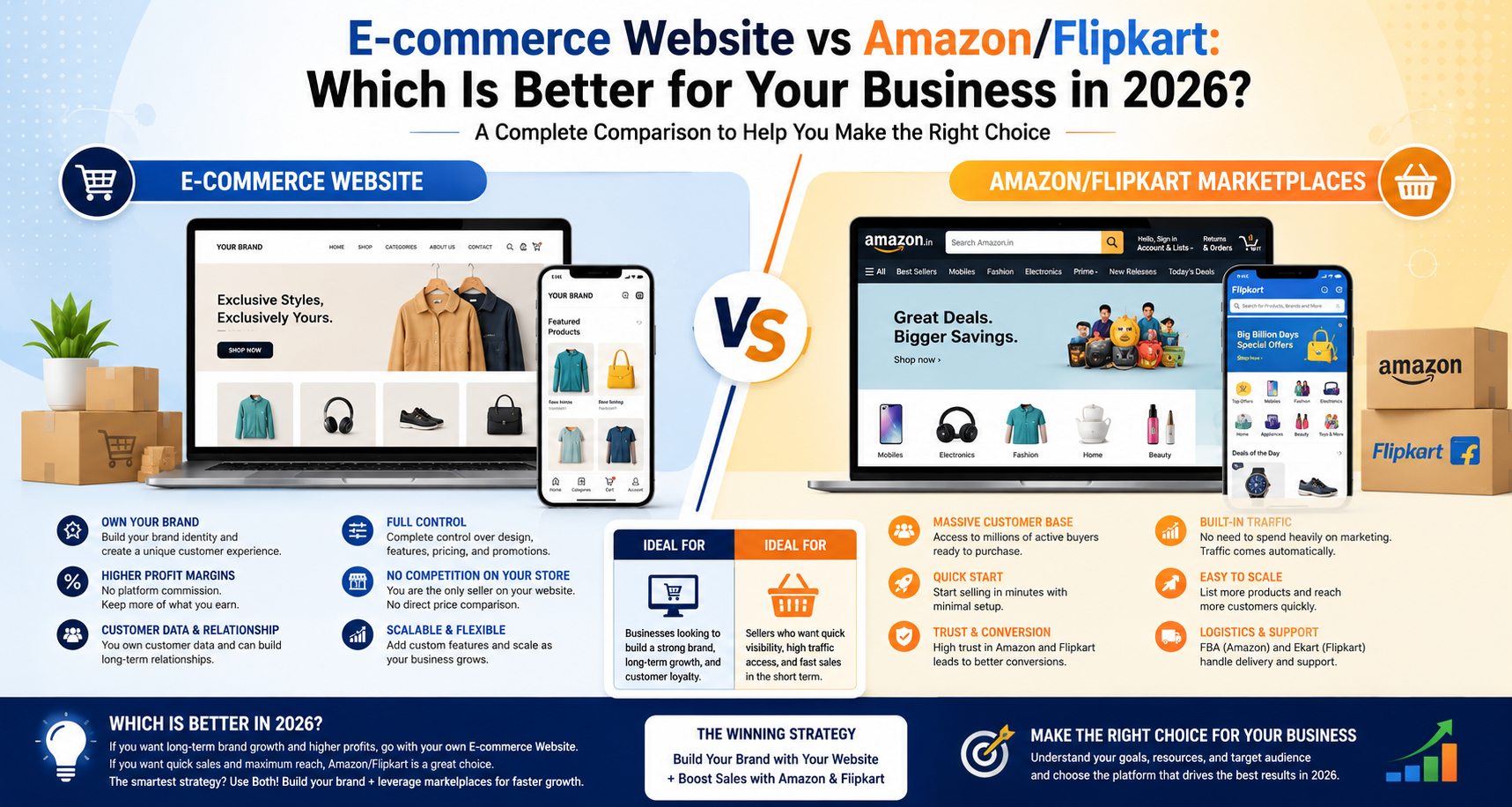
SEO Title: E-commerce Website vs Amazon/Flipkart: Which Is Better in 2026?
Meta Description: E-commerce website vs Amazon and Flipkart in 2026: compare costs, customers, profit margins, branding, marketing, control, and scalability to choose the best option for your business.
Focus Keyword: E-commerce Website vs Amazon/Flipkart
Secondary Keywords:
- Sell on Amazon vs own website
- Amazon vs Flipkart vs own website
- E-commerce business in India
- Sell products online in India
- Amazon seller vs own website
- Flipkart seller vs own website
- Best platform to sell online
- E-commerce website cost in India
- Online business in India 2026
- How to sell products online
Introduction
Starting an online business in India has never been more accessible. Today, sellers have several options for reaching customers, including large marketplaces such as Amazon and Flipkart and their own independent e-commerce websites.
But which option is better?
The answer depends on your business goals, budget, products, marketing strategy, and long-term plans.
Marketplaces can provide access to a huge existing customer base, while an independent e-commerce website gives you greater control over your brand, customer experience, and online store.
For many businesses in 2026, the smartest strategy may not be choosing only one. Using Amazon or Flipkart for customer acquisition while building your own website for long-term brand growth can provide the advantages of both approaches.
Let's compare them in detail.
Selling on Amazon and Flipkart
Amazon and Flipkart are established online marketplaces where businesses can list their products and reach customers who are already shopping online.
Amazon currently states that millions of customers visit Amazon.in and that sellers can reach customers across a very large portion of India's serviceable pincodes. It also provides fulfillment options such as FBA, Easy Ship, and Self-Ship.
This makes marketplaces particularly attractive for new sellers who don't yet have an established audience.
Instead of spending months building website traffic from zero, you can list products on a platform where customers are already searching for products.
Advantages of Amazon and Flipkart
- Access to an existing customer base
- Faster initial product discovery
- Established payment infrastructure
- Marketplace logistics options
- Customer trust
- Advertising and promotional tools
- Seller dashboards and analytics
- Easier testing of new products
- Potential for nationwide sales
Amazon also provides tools for pricing, inventory, advertising, and business analytics, which can be useful as a seller grows.
What Is the Problem With Marketplaces?
The biggest disadvantage is that you are operating on someone else's platform.
Marketplace selling involves various fees that can affect your final profit. Amazon's current seller information explains that profitability needs to account for costs such as referral fees, closing fees, shipping or weight-handling charges, applicable taxes, and product cost.
Your competitors may also be selling similar products directly beside yours.
This can create intense price competition.
For example, if you sell a women's kurti for ₹999 and another seller offers a similar-looking product for ₹899, customers may compare the two listings immediately.
Marketplaces can therefore generate sales, but maintaining healthy margins requires careful product selection and pricing.
Building Your Own E-commerce Website
An independent e-commerce website is your own digital store.
You control the design, product presentation, branding, customer journey, promotions, content, and overall shopping experience.
Instead of customers primarily identifying the marketplace, they interact directly with your brand.
For example, if your company sells women's clothing, you can create a branded store featuring your own logo, colors, collections, product photography, blogs, offers, and customer loyalty programs.
Advantages of Your Own Website
- Complete control over branding
- Greater control over customer experience
- Your own domain and online identity
- More flexibility in pricing and promotions
- Better opportunities for repeat purchases
- Ability to build your own customer database, subject to applicable privacy and consent requirements
- SEO traffic can grow over time
- Direct relationship with customers
- Greater flexibility for loyalty programs
- No direct marketplace competition on every product page
Your website can become a long-term digital asset.
Unlike a marketplace listing, your website can also contain blogs, buying guides, videos, FAQs, comparison pages, and other content that can attract organic search traffic.
E-commerce Website vs Amazon/Flipkart: Comparison
| Factor | Own E-commerce Website | Amazon/Flipkart |
|---|---|---|
| Initial setup | Requires website setup | Easier marketplace onboarding |
| Existing customers | No | Yes |
| Brand control | Very high | Limited |
| Competition | Mainly your own store | Often high |
| Customer relationship | More direct | Marketplace-controlled |
| Marketing | You manage it | Marketplace + your own ads |
| Marketplace fees | No marketplace commission | Applicable selling fees |
| SEO opportunity | High | Limited to marketplace search |
| Customer loyalty | Easier to build | More difficult |
| Product testing | Possible | Excellent |
| Long-term brand building | Excellent | Moderate |
| Control over store design | Complete | Limited |
| Scalability | High | High |
Which Is Better for a New Seller?
If you are just starting with a limited budget and don't yet have an audience, Amazon and Flipkart can be useful starting points.
You can test different products, understand customer demand, collect operational experience, and learn which products generate sales.
For example, if you plan to sell:
- Women's garments
- Shoes
- Home products
- Kitchen products
- Accessories
- Beauty products
- Lifestyle products
you can start with selected products on marketplaces and analyze their performance.
This approach reduces the risk of spending a large amount of money building a complete online store before knowing whether your products have demand.
When Should You Build Your Own Website?
You should seriously consider your own website when you want to build a recognizable brand.
Suppose one of your products starts generating consistent orders on Amazon.
Instead of depending entirely on marketplace sales, you can gradually build a branded website around the business.
Your website can offer:
- Exclusive collections
- Special discounts
- Loyalty programs
- New product launches
- Brand stories
- Product guides
- Customer support
- Blog content
- Email marketing
- WhatsApp-based customer communication, where appropriate
This allows your business to become more than just another marketplace seller.
The Best Strategy in 2026: Use Both
For many businesses, the best strategy is not Amazon OR website.
It is:
Amazon + Flipkart + Your Own E-commerce Website
Each channel can serve a different purpose.
Amazon and Flipkart
Use marketplaces to:
- Find new customers
- Test products
- Generate sales
- Expand nationwide
- Take advantage of marketplace traffic
- Learn about customer demand
Your Own Website
Use your website to:
- Build your brand
- Increase repeat purchases
- Publish SEO content
- Create a unique shopping experience
- Build long-term customer relationships
- Reduce dependence on a single marketplace
Amazon also offers multi-channel fulfillment that can support orders originating from your own website and other sales channels, illustrating how marketplace infrastructure can coexist with an independent store.
Example: Starting With a ₹50,000 Budget
Imagine you have ₹50,000 to start an online clothing business.
Instead of spending the entire amount on website development, you could divide your initial investment between:
Inventory: ₹25,000
Packaging and branding: ₹5,000
Marketplace setup/marketing: ₹8,000
Website/domain/hosting: ₹7,000
Photography/content: ₹5,000
The exact allocation should depend on your products and margins.
The idea is to test demand first while simultaneously creating your own brand presence.
If certain products perform well, you can increase inventory and marketing around those products.
Don't Depend on a Single Platform
One of the biggest lessons for online businesses is diversification.
If 100% of your sales come from one marketplace, changes in fees, policies, competition, account restrictions, advertising costs, or marketplace algorithms can significantly affect your business.
Having multiple sales channels provides greater flexibility.
Your long-term strategy could include:
Amazon → Flipkart → Own Website → Social Media → Other Relevant Marketplaces
The exact combination depends on your product category and target customers.
Final Verdict: Which One Should You Choose?
There is no single answer for every business.
If your priority is getting started quickly and reaching existing online shoppers, Amazon and Flipkart can be excellent channels.
If your priority is building a long-term brand and controlling the customer experience, your own e-commerce website is the stronger foundation.
For most ambitious online businesses in 2026, however, the best approach is to use both.
Start with marketplaces to generate sales and understand your customers. At the same time, build your own website, brand identity, SEO presence, and repeat-customer strategy.
The winning formula is:
Marketplaces for reach + Your website for brand + SEO for long-term traffic + Social media for engagement.
This multi-channel approach can help reduce dependency on a single platform while creating a stronger and more valuable online business over time.
Frequently Asked Questions
1. Is Amazon better than having your own e-commerce website?
Amazon can be better for reaching customers quickly because it already has an established marketplace audience. Your own website is better for building a long-term brand and controlling the customer experience.
2. Is Flipkart good for new sellers?
Flipkart can be useful for sellers who want to reach online shoppers without first building their own website traffic. However, sellers should calculate all applicable marketplace costs and product margins before choosing products.
3. Is it profitable to sell on Amazon and Flipkart?
It can be profitable, but profitability depends on product cost, selling price, marketplace fees, shipping, returns, advertising, taxes, packaging, and other operating expenses.
4. Do I need my own website if I sell on Amazon?
You don't necessarily need one to start selling on Amazon, but having your own website can be valuable for long-term branding, SEO, customer acquisition, and reducing dependence on a single marketplace.
5. What is the best way to sell products online in India in 2026?
For many businesses, a multi-channel strategy is effective: use marketplaces such as Amazon and Flipkart for reach while developing your own e-commerce website for brand building and direct customer acquisition.
6. Can I sell the same products on Amazon, Flipkart, and my own website?
In many cases, yes, provided your products, listings, pricing, inventory, and marketplace policies are managed correctly. A centralized inventory or order-management system can become increasingly useful as your sales channels grow.
7. Should I start with Amazon or my own website?
If you are completely new and have a limited budget, starting with a marketplace can help you test demand. Once you identify products that sell consistently, building your own website can help establish a stronger independent brand.
Conclusion
The choice between an e-commerce website and Amazon or Flipkart doesn't have to be an either-or decision.
Marketplaces can help you reach customers faster, while your own website can help you build a valuable long-term brand.
For a new Indian e-commerce business in 2026, a practical strategy is to start selling on established marketplaces, identify winning products, build a professional e-commerce website, and gradually develop multiple sources of traffic and sales.
The ultimate goal should not simply be to sell products online.
It should be to build a recognizable, profitable, and sustainable e-commerce brand.